
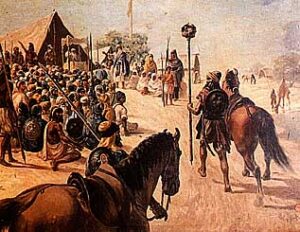
The Mughal government had started an all-out campaign against the Sikhs. As a result, most of the Sikhs had left the plains. They had taken shelter in places like the Shivalik hills, jungles and sandy deserts. Sometimes, however, they used to come out of their hiding and make their presence felt. One such occasion was Nadir Sash’s invasion of India. Nadir Shah of Persia had overrun the Punjab and plundered Delhi in the early months of 1739. On the way back, he decided to avoid the heat of the plains. So he took a northerly route under the Shivalik hills. A number of Sikhs were passing their days in those hills. They decided to plunder the invader and plunderer. They fell on the rear of the hindermost part of his army. They took away much of his booty. This action astonished Nadir Shah. He called a halt at Lahore. He enquired from Zakriya Khan ‘Who are these people who have dared to interfere with my onward march ? Who are these bold mischief-makers ?’ Zakriya Khan replied, ‘They are a group of fakirs. They visit their Guru’s tank at Amritsar twice a year. After bathing they disappear.’ ‘Where do they live ?’ asked Nadir Shah. ‘Their saddles are their homes,’ replied the governor. ‘Take care’, said Nadir Shah, the day is not far off when they will take possession of your country.’
‘Nadir Shah’s remark cut Zakriya Khan to the quick. He resolved to intensify his campaign against the Sikhs. He re-started the practice of offering rewards for their capture and destruction. Thousands of Sikhs were killed. Soon, the plains seemed to have been cleared of them. However, another action still was taken against them. The Darbar Sahib of Amritsar was occupied. Its approaches were guarded by military pickets. The latter prevented the Sikhs from assembling in their favorite sacred place. Massa Ranghar of Mandiali was put in charge of the Darbar Sahib. He was the most active of the Chaudries engaged in capturing and destroying Sikhs. The inmost Gurdwara was turned into a notch-house (dance hall). He used to smoke and drink, and enjoy the dance of public women there. The news of this disrespectful used of the sacred Gurdwara was conveyed by some persons to a party of Sikhs living in Jaipur, Rajputana. One of those Sikhs was Bhai Mehtab Singh. He was a GurSikh of Mirankot, near Amritsar. He was astonished at the news. He said to the messenger, “You have heard of this outrage to the sacred place, and yet you still live and go about telling the news to others ! Why was not Massa killed then and there ? Is there no Sikh left ?” ‘No, ‘replied the messenger. ‘There is no Sikh there with a greater sense of honor then those who have run away to places like Jaipur in order to save their lives.’ Bhai Mehtab Singh was a strong bodied brave young man. The messenger’s taunt stung him like a scorpion. He stood up at once, took his sword, and said, ‘I shall go and cut off Massa’s head with this sword, and bring it here. He saddled his horse and got ready to gallop away. Bhai Sukha Singh of Mari Kambo offered to go with him. Both galloped off towards Amritsar. When they arrived close to the sacred city, they disguised themselves as Muhammadans. They filled two bags with well rounded pieces of broken earthen pots. Each of them placed one of the bags before him on the horse. They looked like Muhammadan Lambardars come to pay their land revenue.
They reached Amritsar in August 1740. They entered the precincts of the Gurdwara. To the guards they said, ‘We have to come pay land revenue to our Chaudri.’ They were allowed to go in. They tied their horses outside the main gate. The ber tree to the which horses were tied still exists. They came to Massa Ranghar. He was seated on a cot, smoking a hukka. He was intoxicated with wine. With half closed eyes he was listening to the music of dancing girls. The sight made their blood boil. Bhai Sukha Singh stood watch near the door. Bhai Mehtab Singh went in and fell on the tyrant like lightning. With one stroke of his sword he cut off Massa’s head. Massa’s companions were taken by surprise. They ran about in terror. Before they could recover from their surprise and shock, Bhai Sukha Singh and Mehtab Singh had made good their escape and galloped away. Zakriya Khan soon heard of Massa Ranghar’s end. He was beside himself with rage on hearing of the daring deed of the two Sikhs. He summoned all Chaudhries of the pagans around Amritsar. He ordered them to find out and bring him the murderer of Massa. A handsome prize was promised for his capture. Harbhagat Niranjinia of Jandiala was a sworn enemy of the Sikhs. He had helped the government to hunt them. He came forward and promised to do his best in this case, too. He discovered that Bhai Mehtab Singh had murdered Massa. He conveyed his information to the governor. Thereupon, Bhai Mehtab Singh’s village, Mirankot, was surrounded by a strong force under the command of one Nur Din, Harbhagat accompanied the force.
Bhai Mehtab Singh, of course, was not found there. But his little son, Rai Singh, was there. Before leaving the village, Bhai Mehtab Singh had placed his little son under the protection of the village Lambardar. The latter’s name was Natha Khaihra. Nur Din sent for him. He was told to bring the child with him. But Natha did not want to hand over the child to those butchers. Lifting him on his shoulder, he left the village by the back door. Three or four other villagers were with him. Nur Din’s men learnt of his escape. Harbhagat, together with some soldiers, hurried after Natha and his companions. He overtook them soon and attacked them. A fierce fight took place between the two parties. Nathanand and his companions were killed. Rai Singh was seriously wounded. Harbhagat took him for dead. He went back, leaving the wounded child there. A Kambo woman happened to pass that way. She saw the wounded child and finding him still alive, she took him home. Under her motherly care, Rai Singh recovered in due course. In the year 1745, Bhai Mehtab Singh came to his village in order to see his family and friends. Some evil person informed the local Muslim official that he was there. Bhai Mehtab Singh was captured, chained, and taken to Lahore. There he was told to choose between Islam and death. He stoutly refused to give up his faith. He chose death. He said, ‘No true Sikh can ever agree to give up his faith, to turn his back on the Guru. I shall die a Sikh.’ Thereupon, he was publicly broken on the wheel. That was a most painful mode of killing. Bhai Mehtab Singh remained calm all the time. He did not utter even a single groan or cry of pain. He kept meditating on God and repeating His name.
His head then was cut off. It was hung up in Hiramandi. His body was thrown into a ditch. Bhai Mehtab Singh was killed, and killed, with the utmost brutality. But he is not really dead. Like all martyrs, he is still alive. His memory will last as long as the holy Harmandar at Amritsar still stands. We know that he tied his horse to a ber tree outside the holy place. That tree still exists. Visitors to the Golden Temple respectfully touch and salute the said ber tree. They recall and admire the daring, noble deed of the great Sikh martyr. In this way he lives and shall live for ever.
Excerpts taken from these books.
Sikh History Book 5 by Kartar Singh ji.
Published by Hemkunt Press, New Delhi
Bhai Sukha Singh and Bhai Mehtab Singh
From SikhiWiki
Jump to: navigation, search
Early in the year of 1739
The Mughal government had started an all-out campaign against the Sikhs. As a result, most of the Sikhs had left the plains. They had taken shelter in places like the Shivalik hills, jungles and sandy deserts. Sometimes, however, they used to come out of their hiding and make their presence felt. One such occasion was during Nadir Shah’s invasion of India. The Shah of Persia had overrun the Punjab and plundered Delhi in the early months of 1739. On the way back, he decided to avoid the heat of the plains. So he took a northerly route at the bottom of the Shivalik hills. It happened that a number of Sikhs were passing their days hiding out in those very hills. They decided to plunder the plunderer and relieve the foriegn invader of his ill gotten treasures. They fell on the rear of the trailing units of his army. They took away so much of his booty that the astonished Nadir Shah stopped at Lahore where he asked the man he had assigned to govern Lahore, “Who are these people who have dared to interfere with my onward march? Who are these bold mischief-makers”? Zakriya Khan replied, “They are a group of fakirs who visit their Guru’s tank at Amritsar twice a year. After bathing they disappear.”
“Where do they live ?” asked Nadir Shah. “Their saddles are their homes,” replied the governor. “Take care”, said Nadir Shah, “the day is not far off when they will take possession of your country.”
Nadir Shah’s remark had cut Zakriya Khan to the quick. He resolved to intensify his campaign against the Sikhs. He re-started his former policy of offering rewards for their capture and destruction. Thousands of Sikhs were killed. Soon, the plains seemed to have been cleared of them. However, another action still was soon to be taken against them. Zakriya Khan had the the Darbar Sahib of Amritsar occupied. The city was sealed off with its approaches guarded by military pickets. As intended this prevented the Sikhs from assembling in their most sacred Holy place during the events which had rrawn them to the city since its establishment by Guru Arjan.
Now the military commander Massa Ranghar of Mandiali village was put in charge of the Darbar Sahib. He was the most active of the Chaudries engaged in capturing and destroying Sikhs. The Harmandir Sahib was turned into a place for debauchery with nauch (dance) girls being housed their for Massa Ranghar entertainment. The use of Naquills (water pipes) was by then a daily practice for Moslems, so the odor and smoke of tobacco, a substance which Guru Gobind Singh had forbidden his Sikhs to use, now filled the halls of the Sikhs’ most Holy site, the very rooms where the beloved first Holy book and the SGGS had enjoyed Prakash for years. Alcohol in wine and other forms, forbidden even by the Moslem’s own Holy book the Qur’an, now flowed freely as Massa Rangar and his friends enjoyed the dancing and other activities that the nautch girls were famed for. For the Sikhs whose Bani and Holy writings forbid the use of alcohol totally this was one but one more final insult.
The news that their sacred Gurdwara was now being used as a Seraglio, with wine and tobacco staining its walls and floors soon fell on the ears of a group of Sikhs living in Jaipur in Rajputana. Bhai Mehtab Singh a GurSikh of Mirankot, a village near Amritsar, was one of the first to hear this alarming news. Astonished and angered by the news he questioned the man who had just relayed the story:
“You have heard of this outrage to the sacred place, and yet you still live and go about telling this news to others! Why did you not kill Massa then and there? Is there no Sikh left in Amritsar to avenge this evil?” “No”, replied the messenger. “There are no Sikhs there with a greater sense of honor than those who have run away to places like Jaipur in order to save their lives.”
The messenger’s taunt stung Bhai Mehtab Singh, a brave, strong minded and stout bodied young man, like the sting of some deadly dessert scorpion. He bolted up at once, took his sword and said:
“I shall go and cut off Massa’s head with this sword, and bring it here!”
He saddled his horse and got ready to gallop away. A bystander who had heard the news as well Bhai Sukha Singh of the village Mardi Kambo ki offered to go along with him. Mounting their horses, they took off towards Amritsar. When they reached the sacred city, in August 1740 they noted the Mughal outposts, so they took some time to disguise themselves as Muhammadans. They filled two bags with well rounded pieces of broken earthen pots. Each of them placed one of the bags before him on the horse. They looked like harmless Muhammadan Lambardars who had come to pay their land revenue.
They entered the precincts of the Gurudwara. To the guards they said, “We have to come pay land revenue to our Chaudri.” Their ruse worked and they were allowed to go into the compound of the Holy Temple. Tying their horses to a ber tree outside the main gate, the ber tree to the which horses were tied still exists, and carrying their sacks of payment they entered the room where they saw Massa Ranghar. He was seated on a cot, smoking a hukka, they could tell that he was intoxicated with wine. With half closed eyes he was listening to the music of the dancing girls. The sight made their blood boil. Bhai Sukha Singh stood watch near the door. Bhai Mehtab Singh went in and fell on the tyrant like lightning. With one stroke of his sword he cut off Massa’s head.
Massa’s companions were taken by surprise. They ran about in terror. Before they could recover from their surprise and shock, Bhai Sukha Singh and Mehtab Singh had made good their escape and galloped away. Zakriya Khan soon heard of Massa Ranghar’s death. He was beside himself with rage on hearing of the daring deed of the two Sikhs. He summoned all the Muslim Chaudhries around Amritsar. He ordered them to find out who the men were and to catch them and bring him the killers of Massa. A handsome prize was promised for their capture. Hearing this, Harbhagat Niranjinia of Jandiala, a sworn enemy of the Sikhs who had helped the government to hunt them down in the past came forward and promised to do his best to bring the men to justice.
A village surrounded
He discovered that it was Bhai Mehtab Singh who had murdered Massa. He conveyed his information to the governor. Thereupon, Bhai Mehtab Singh’s village, Mirankot, was surrounded by a strong force under the command of one Nur ud’Din, Harbhagat accompanied the force. Bhai Mehtab Singh, of course, was not found there. But his little son, Rai Singh, was there. Before leaving the village, Bhai Mehtab Singh had placed his little son under the protection of the village Lambardar. The latter’s name was Natha Khaihra. Nur Din sent for him. He was told to bring the child with him. But Natha did not want to hand over the child to those butchers. Lifting him on his shoulder, he left the village by anoher gateway. Three or four villagers accompanied him. Nur Din’s men learned of his escape.
Harbhagat, together with some soldiers, hurried after Natha and his companions. He overtook them soon and attacked them. A fierce fight took place between the two parties. Nathan and and his companions were killed. Rai Singh was seriously wounded, but Harbhagat thinking he was dead he left the motionless child with the dead villagers bodies and returned to the village. A Kambo woman happened to pass that way where she found that the child was only wounded still clinging to life. She took him to her home where, under her motherly care, Rai Singh recovered in due course.
In the year 1745, Bhai Mehtab Singh came to his village in order to see his family and friends. Some evil person informed the local Muslim official that he was there. Bhai Mehtab Singh was captured, chained, and taken to Lahore. There he was given the chance to choose between Islam and death. He stoutly refused to give up his faith choosing death. He said:
‘No true Sikh can ever agree to give up his faith, to turn his back on the Guru. I shall die a Sikh.”
Thereupon, he was publicly broken on the ‘wheel’. The ‘wheel’ an ancient torture device was a most painful mode of killing someone. However painful it must have been, Bhai Mehtab Singh did not utter even a single groan or cry of pain. The whole time he kept meditating, on God while he repeated WaheGuru. Bhai Mehtab Singh remained calm until his death.
His head was then cut off and hung up in Hiramandi. His body was thrown into a ditch. Bhai Mehtab Singh was killed with the utmost brutality, but he is not really dead. Like all martyrs, he is still alive. His memory will last as long as the holy Harmandar at Amritsar still stands. We know that he tied his horse to a ber tree outside the holy place. That tree still exists. Visitors to the Golden Temple respectfully touch and salute that very ber tree even today while they recall in admiration the daring, noble deed of the great Sikh martyr. He shall live forever. As for Bhai Sukha Singh, after the death of Massa Rangar, Bhai Sukha Singh was given a charge of a Jatha. In early 1746 he joined Jassa Singh Allhuwalia and entered Eminabad in Gujjaranwala District, here they were attacked by Jaspat Rai the brother of Lakhpat Rai, a Revenue officer of Yahiya Khan the governor of Lahore. Jaspat Rai was killed in this battle and Lakhpat Rai swore revenge against all the sikhs, they met at Kahnuvan village in what is known as the Chotta Ghalugharra, this was on the 1st of may 1746, Bhai Sukha Singh was badly injured in the battle but he managed to escape with few remaining sikhs to the sandy plains of the Malwa area. During the third invasion of Ahmed Shah Durrani in January 1752, Durrani had camped on the norther bank of River Ravi near Shahdara preparatory to attack Lahore. It was while out on foraging expedition that Bhai Sukha Singh and few sikhs encountered a strong body of enemy troops, a fierce battle took place and all the sikhs died fighting, this was in early january 1752.
SIKH MARTYRS: BHAI SUKHA SINGH BHAI MEHTAB SINGH JI
PANTHIC.ORG STAFF
After the invasion of Nadir Shah and acting on his advice Nawab Zakaria Khan decided to totally exterminate the Sikh community once for all. To achieve this objective, he issued instructions to his officials and to village heads to kill or arrest alive Sikhs, wherever and whenever found. He also announced cash rewards of Rupees ten, fifty and eighty respectively for informers, killers and arresters of the Sikhs.
[edit] Sikh Persecution
Punjab had gone through an era of Sikh persecution under the Mughal governor of Lahore Zakriya Khan from 1726 to 1745 A.D. The Sikhs of Punjab had taken refuge in the deserts of the Rajputana.
[edit] Desecration of Harmandir Sahib
In 1740, the governor of Lahore put Massa Ranghar or Musalul Khan, a Chaudhury of Mandiala as the incharge of the Harmandir Sahib (Golden Temple). Sikhs were not allowed to visit the Harmandir Sahib or to take a dip in the holy waters of its tank (sarovar). Massa Ranghar persecuted the Sikhs and looted the shops and home of Hindus. He watched the dancing girls perform, drank alcohol and smoked hookah inside the Harminder Sahib.
[edit] News from Amritsar
Two residents of Amritsar Tej Ram, a Hindu and Bulaka Singh took this news to a band of Khalsa in the deserts of Bikaner under the leadership of Sardar Sham Singh. Tej Ram and Bulaka Singh narrated their stories to the congregation of Sikhs. After listening Sardar Mehtab Singh Bhangu volunteered to bring Massa Ranghar’s head back to Bikaner. Another Sikh, Sardar Sukha Singh of Mari Kamboki also stood up and asked to accompany Mehtab Singh.
Both of the Sikhs disguised themselves as landlords (Chaudhries) bringing revenue to Amritsar. They rode across the desert and reached Damdama Sahib at Talwandi Sabo near Bathinda. They filled up bags of broken pottery pieces and made them look as if they are full of coins.
[edit] Revenge at Harmandir Sahib
On August 11, 1740 A.D. they dressed up as landlords from Patti and entered the city of Amritsar. They reached the Harmandir Sahib and them tied their horses to the berry tree and went inside the Harmandir Sahib carrying the bags. Massa Ranghar was smoking the hukkah and watching the dancing girls. The Sikhs threw the bags under Massa’s bed and said that they had come to pay the revenue. Massa bent downwards to have a look at the bags. Mehtab Singh immediately took his sword and slashed it at Massa’s neck and instantly severed his head. Sukha Singh finished off the guards of Massa Ranghar. They put Massa’s head in a bag and rode their horses back to Talwandi Sabo the same evening. The next day they reached Bikaner and presented Massa Ranghar’s head on a spear to the congregation (Dal) of Sikhs.
[edit] Further struggle
Early in 1752, Ahmad Shah Durrani came out leading his third invasion into India and camped at Shahdara preparatory to an attack on the Punjab capital. A fierce action took place in which Sukkha Singh and his men died fighting to Durrani’s strong troopsmen.
As a result of these orders of Zakaria Khan, the Governor of Lahore (now in Pakistan) thousands of Sikhs, men, women and children were killed and arrested without any rhyme or reason. The notorious village heads and officials who carried out the orders of the Governor to gain his favours were Karma of village Chheena, Rama Randhawa of village Talwandi, Sahib Rai Sandhu of village Naushehra Dhaala, Har Bhagat Niranjania of village Jandiala, Dharam Das Topi of Jodhnagar and village heads of villages Naushehdra Punuan and Majitha. They sent cart loads of heads of Sikhs to Lahore, in addition to thousands arrested and sent to Lahore for execution in a merciless manner publicly in Lahore daily. They even killed women and presented their heads for reward.
Massa Ranghar, the village head of Mandially exceeded all limits and behaved in a most hated, mischievous and offensive manner, hurting religious sentiments of Sikhs, after he was handed over charge of Sri Darbar Sahib (Golden Temple), in Amritsar. The premises was captured earlier by the Governement forces.
He used parikarma of the premises as stable for horses and main Hall of holy Golden Temple as a Dancing Room. He would seat himself on a beautiful cot (Palang), smoke hukka and watch prostitutes dancing in the main hall of the most sacred place of the Sikh community. Around the building he had posted armed guards to prevent entry of anyone and everyone without permission.
Due to persecution in Punjab the Sikhs had moved to hills, Jungles, ravines and deserts. One such group (Jatha) of Sikhs was temporarily camping near Jaipur City in Rajasthan. Some-one communicated to them the sad news of desecration of Harimandir Sahib at Amritsr. The heart rendering account of misdeeds of Mass a hanghar sent shock waves through the hearts of all the sikhs present there. One among them, Bhai Mehtab Singh immediately jumped to his feet and volunteered himself to punish and culprit Massa Rangar forthwith. He announced that he would serve the head of the wretched Massa in Amritsar and bring it back in Jaipur to show the same to all Sikhs present here. Another Sikh named Bhai Sukha Singh volunteered to accompany Mehtab Singh, to help him accomplish the sacred task. Both were granted permission by the Jatha chief and special prayer was held for the success of their mission.
Both Bhai Sukha Singh and Bhai Mehtab Singh immediately proceeded towards Amritsar and arrived there in the month of August, 1740. They put on the garbs of village chaudharies and carried with them a bag full of well ground pieces of broken earthen wared and thus it appeared that the bag was full of coins.
They straightway headed for Harmandir Sahib. On arriving there, they told the guards who checked their entry into the premises that they were village heads and had come to deposit land revenue with Massa Ranghar. Thus they managed to befool the guards and gained entry to Harimandir Sahib. They tied their horses with a tree near the entrance of the Harimandir Sahib now reveredly known as Lachi Ber and proceeded further. They found Massa Ranghar sitting on his cot fully intoxicated, smoking Hukka and watching dancing prostitutes. The scene enraged them. Bhai Sukha Singh remained near the door of main hall while Bhai Mahtab Singh went inside. He threw the bag under Massa’s cot and said, “ Here is land revenue.” Massa Rangar happily bent down to pick up the bag supposed to be full of coins. Bhai Mehtab Singh drew out his sword swiftly and with its single blow, cut off the head of Massa Rangar. Those present inside were stunned by the dudden development and ran helter shelter. In the meantime the two brave Sikhs took away the severed head of Massa Rangar, rode their horses and vanished from the scene before the guards could recover and realise what had happened inside Harimandir Sahib. They went straight to Jaipur showed Massa’s severed head to their Jathedar and othe colleagues there by redeeming their pledge.
When Zakaria Khan, the Governor of Lahore, came to know of murder of Mass Rangar his anger knew no bounds. He immediately summoned village heads of all villages around Amritsar and ordered them to find out and arrest the culprits forthwith. Harbhagat Niranjania suspected it to be the handi-work of Bhai Mehtab Singh of Minarkot village. He told Zakaria Khan about his suspicion. Noorudin Faujdar, proceeded to Mirankot village accompanied by a band of soldiers with orders to arrest Bhai Mehtab Singh. Bhai Mehtab Singh was not present at his home but his infant son, Rai Singh was there. While leaving the village, Bhai Mehtab Singh had left his son in the safe custody of a noble person and his friend Natha Khaira. When Natha Khaira came to know of arrival of Govt. soldiers for arresting Bhai Mehtab Singh, he escaped from the village accompanied by Mehtab Singh’s son Rai Singh with the help of his friends. Nooruddin Faujdar come to know of the escape of the child Rai Singh and hotly pursued Natha’s party and caught up with the escapes. Natha and his trusted friends put up a brave fight and died fighting. The child Rai Singh was also gravely injured. Taking the child as dead, the Govt. soldiers went away. A kind woman passing that way happened to notice the child who was still alive. She took the child home and with her care and proper treatment the child recovered from the injuries fully.
Five years later, in 1745 A.D., Bhai Mehtab Singh visited his village home to see his son. He was arrested with the help of some informer. He was brought to Lahore. Zakaria Khan ordered his execution through a most dreadful method.
Bhai Mehtab Singh was put on the Charkhari (Consisting of two wheels fitted with sharp nails). The Charkhari (the two wheels) was rotated and the body of Bhai Mehtab Singh was cut by the iron nails fitted on the wheels, bit by bit. Thus Bhai Mehtab Singh was put to death in a brutal manner, but he was happy to lay down his life with the satisfaction that the desecration of the Sacred Harimandir Sahib had been avenged by him by the killing of Massa Ranghar. By his action, he proved that Sikhs do not tolerate desecration of their holy places and hold sancity of their holy places more dear than their lives.
Bhai Mehtab Singh
From SikhiWiki
Jump to: navigation, search
Bhai Mehtab Singh (d. 1745), eighteenth century Sikh warrior and martyr, was born the son of Hara Singh, a Sikh of Bhangu clan of the village of Mirarikot, 8 km north of Amritsar. He grew up amidst the most ruthless persecution Sikhs suffered under the later Mughals, and like many another spirited youth joined one of the several small guerilla bands into which they had organized themselves after the capture and execution, in 1716, of Banda Singh Bahadur. Nadir Shah‘s invasion, while it violently shook the already crumbling edifice of the Mughal empire, so emboldened the Sikhs that they attacked and robbed even the invader’s rear on his way back. Zakariya Khan, the governor of the Punjab from 1726 to 1745, further intensified his campaign against the Sikhs, forcing them to seek safety in hills and deserts beyond the central Punjab. Matab Singh, entrusting his family to the care of a village elder, and Natlha, a Khahira Jatt, went, according to his grandson, Ratan Singh Bhangu, the author of Prachin Panth Prakash, to Jaipur in Rajasthan, where he took up employment under the local ruler.
It was at Jaipur that he learnt how Massa Khan Ranghar, the new kotwal (officer-in-charge) of Amritsar, had occupied the holy Harmandar and converted it into a pleasure house. Resolved to avenge the sacrilege, Matab Singh left forthwith for Amritsar, accompanied by another bold warrior, Bhai Sukha Singh of Marhi Kambho Ke village in Amritsar district. They disguised themselves as tax collectors carrying on their backs bags seemingly filled with money. “It was a scorching noon of the month of Bhadori,” narrates Ratan Singh Bharigu. “A strong wind raised a lot of dust, giving the two an excuse to cover their faces. Massa [inside the sacred sanctuary] was enjoying music appropriate to the rainy season. The guards were either resting under shelters or listening to the songs of the dancing girls. The two [Matab Singh and Sukkha Singh] got their God given chance. They hid their horses and spears outside the main entrance, one at either side, concealed their swords under their armpits, and advanced as if they were just some soldiers who had come with their collection of tax. Walking smartly, they reached where the mrdang [Indian doublesided drum] was being played. One of them immediately drew his sword and severed Massa’s head like a gourd is plucked off the plant, while the other removed the ornaments from the body. There arose an instant tumult, but the two rode away on their horses and vanished into the forest.” This happened on 11 August 1740.
Matab Singh’s ancestral village of Mirarikot was raided by a strong military contingent under Faujadar Nurdin. Naltha, the village elder, and his son, nephew and two servants were killed while attempting to escape with their ward, Rai Singh, the young son of Matab Singh. Rai Singh was also grievously wounded and was left for dead. But of Matab Singh there was no trace, until five years later, when on receiving the news of the arrest of Bhai Taru Singh, he surrendered himself voluntarily to die by Bhai Taru’s side. The harshest torments were reserved for both. Bhai Taru Singh had his scalp scraped from his skull with lancets and Matab Singh was broken on the wheel in the Nakhas square in Lahore.
See also
- Massa Rangarh
- From SikhiWiki
- Jump to: navigation, search
- Sukha and mehtab singh bring the head of massarangar
- Chowdhary Massa Rangar was traitor of Mandiali (also known as Mandiala, which is in Nakodar, Punjab), who desecrating the Golden Temple in 1740. He was put to death by Sukha Singh and Mehtab Singh. Chowdhary Massa Rangar of Mandiali was the most notorious and in charge of the Amritsar circle. He desecrated the Golden Temple by smoking and drinking inside there while watching dancing girls. Armed watchmen were posted around for his safety.
- Zakaria Khan, irritated by the Sikhs’ resistance and his failure to subdue them, obtained the orders from Nadar Shah Durrani to annihilate the Sikhs from Punjab. Accordingly, it was advertised that if a person helps to catch or kill a Sikh, he would be rewarded handsomely. To steal and rob from Sikhs was made legal. These orders of the government motivated many greedy people to become traitors. Cart-loads of severed heads of the Sikhs were sent to Lahore by such people to win government rewards. These traitors included Harbhagat Niranjania Chowdhary (a petty village official) of Majitha, Chowdhary of Noshaira Pannu, and Chowdhary Massa Rangar of Mandiali.
- When the Sikhs in Bikaner heard about the desecration of their holy place of worship they became very angry. Bhai Sukha Singh and Bhai Mehtab Singh decided to go to Amritsar and stop the desecration. When the Sikhs reached the Golden Temple they passed by the watchmen without anyone even lifting a finger against them. The watchmen assumed by seeing the “coin bags” that the two village collectors were going to the Chowdhary for depositing their money. When the Sikhs got inside the Harimandar Sahib the bags were put before Massa, who was drunk and watching the dances of the girls. When he bent to feel the “coins” in the bags, a sword fell like lightning and cut off his head which was picked up by the Sikhs. Before the people inside or outside the Temple could compose themselves and know what had happened, the Sikhs on their horses had vanished. The job was performed so successfully that it brought great shame to the administration and the police of Amritsar.
Zakariya Khan
From SikhiWiki
Jump to: navigation, search
Mass execution of Sikhs in Lahore during the time of Zakariya Khan
Zakariya Khan (d. 1 July 1745) was the Mughal governor of Lahore from 1726 onwards when he replaced his father ‘Abd us-Samad Khan’ as governor of this famous historic city and province now part of Pakistan. He had earlier acted as the governor of Jammu from 1713 to 1720 and of Kashmir from 1720 to 1726. He had also taken part in the Lahore government’s operations against the Sikh leader Banda Singh Bahadur. After the capture of Banda Singh and his companions in December 1715 at Gurdas Nangal, he escorted the prisoners to Delhi, rounding up Sikhs that he could find in villages along the route. As he reached the Mughal capital, the caravan comprised seven hundred bullock carts full of severed heads and over seven hundred captives.
Contents [hide] |
Mass torture and persecution of Sikhs
After becoming the governor of the province in 1726, Khan Bahadur Zakariya Khan, shortened to “Khanu” by Sikhs, launched a still severer policy against the Sikhs and let loose terror upon them. His moving military columns forced the Sikhs to seek shelter in remote hills and forests. Yet Sikh bands continued harassing the administration attacking government caravans and treasuries. Such was the effect of their depredations that Zakariya Khan was obliged to make terms with them. In 1733, he decided to lift the quarantine forced upon the Sikhs and made an offer of a grant.
His envoy, Subeg Singh, a Sikh resident of the village of Jambar, near Lahore, who was at the time the kotwal (police inspector) of the city under Muslim authority, reached Amritsar where the Sikhs had been allowed to assemble and celebrate the festival of Baisakhi after many years of exile, and offered them on behalf of the government the title of Nawab and a jagir consisting of the parganahs of Dipalpur, Kanganval and Jhabal, worth a lakh of rupees in revenue each year. But the entente soon came to an end, before the harvest of 1735, Zakariya Khan sent a force and occupied the jagir. The Sikhs were driven away towards the Malva region by Lakhpat Rai, the Hindu minister at the Mughal court at Lahore. In the clashes that followed many officers of the Lahore army, including Lakhpat Rai’s nephew Duni Chand, were killed. Zakariya Khan took the field himself to re-establish his authority in the region.
Rewards given for crime against Sikhs
Bhai Mani Singh Shaheed tortured by order of Zakariya Khan
He had the fortress of Dalleval blown up and ordered village officials to capture Sikhs and hand them over for execution. A graded scale of rewards was laid down – a blanket for cutting off a Sikh’s hair; ten rupees for information about the whereabouts of a Sikh; fifty rupees for a Sikh scalp. Plunder of Sikh homes was made lawful; giving shelter to Sikhs or withholding information about their movements was made a capital offence.
Zakariya Khan’s police, consisting of nearly 20,000 men especially recruited for this purpose, scoured the countryside and brought back hundreds of Sikhs in chains. Prominent Sikhs including the revered Bhai Mani Singh and Bhai Tariff Singh were, after the severest of torments, publicly beheaded at the Nakhas, the horse-market of Lahore, renamed by Sikhs “Shahidganj” in honour of the martyrs. Yet Zakariya Khan remained unsuccessful in his object of vanquishing the Sikhs. He died at Lahore on 1 July 1745 a dispirited man, bequeathing to his sons and successors chaos and confusion.