
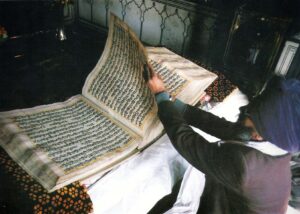
 Guru Granth Sahib or Adi Sri Granth Sahib Ji (Punjabi ਗੁਰੂ ਗ੍ਰੰਥ ਸਾਹਿਬ; also called the Adi Granth or Adi Guru Darbar) is more than just a scripture of the Sikhs, for the Sikhs regard and respect the Granth (holy book) as their living Guru. The revealed holy text spans 1430 pages and contains the actual words spoken by the founders of the Sikh religion (the Ten Gurus of Sikhism).
Guru Granth Sahib was bestowed the Guruship by the last of the human form Sikh Masters, Guru Gobind Singh Ji in 1708. Before passing away, Guru Gobind Singh Ji decreed that the Sikhs were to regard the Granth Sahib as their next and everlasting Guru. Guru Ji said – “Sab Sikhan ko hokam hai Guru Manyo Granth” meaning “All Sikhs are commanded to take the Granth as Guru”. So today, if asked, the Sikhs will tell you that they have a total of 11 Gurus. (10 Gurus in human form, and the eternal shabad Guru, the Guru Granth Sahib).
Unique amongst the world’s major religious scriptures, while compiling the Guru Granth Sahib, the Sikh Gurus incorporated not only their own writings, but also included the writings of other contemporary saints from Hinduism and Islam (including saints belonging to the lowest strata of untouchables in the Hindu Caste System), who believed in the unity of God and denounced superstition and caste. Further, the composition and compilation of the Guru Granth Sahib was performed by the Sikh Gurus themselves, rather than being performed by their adherents and followers, an aspect that has been highlighted by historian-scholars while discussing the authenticity of the preachings of the different teachers and prophets of the world, as known to mankind today.
When one visits a Gurdwara (a Sikh temple), the Guru Granth Sahib forms the main part of the Darbar Sahib or Main Hall. The holy book is placed on a dominant platform and covered in a very beautiful and attractively coloured fine cloth. The platform is always covered by a canopy, which is also decorated in expensive and very attractive coloured materials. The text in which the Granth is written is a script called Gurmukhi (literally “From the Guru’s mouth”), which is considered a modern development of the ancient language called Sanskrit.
Guru Nanak brought the Word of God to manifest upon Earth. Through his Hymns and Prayers (Shabads), he inspired and uplifted humankind to live a life of truth, righteousness and spirituality. These enlightening words were sung by his companions, Bala and Mardana, and by the Sangats (congregations) tha grew up around Guru Nanak. In his later years at Kartarpur, it became customary for the members of the Sikh community to sing certain hymns on a daily basis: Japji in the morning; So Dar and So Purakh, the beginnings of Rehiras, in the evenings.
Guru Angad, Guru Amar Das and Guru Ram Das all composed Shabads (hymns), and the Sikhs began to collect these in small books, called Pothis. Chanting these Shabads, the Sikhs became vehicles for the vibrations of the “Word of God”, and they achieved a state of higher consciousness, a transcendent meditative union with God and Guru.
Standardisation of Shabads

A Granthi reads from the Sri Guru Granth Sahib on the first floor of Harimandir Sahib
Even early in Sikh history, however, there were mal-quotations, and pretenders to the Throne of Spirituality. The elder brother of Guru Arjun, Prithia, composed his own hymns and passed them off as writings of Guru Nanak. Although pothis existed of authentic Gurbani, there were many different collections of Shabads, and many differing versions of the same Shabads.
Guru Arjun realized that a standardized, authenticated collection of the Guru’s Bani (called Gurbani) was needed to preserve the integrity of the Shabad. The most complete collection of Shabads of Guru Nanak, Guru Angad and Guru Amar Das was in the possession of Mohan, a son of Guru Amar Das.
Retrieving the Pothi from Mohan
Guru Arjun sent Bhai Gurdas to Mohan’s home in Goindwal, to request this collection of Shabads. Mohan felt slighted at having been passed over for Guruship — his father, Guru Amar Das, had seen the Divine Light in Guru Ram Das, and had bestowed the Guruship upon him. Mohan refused to answer the door when Bhai Gurdas knocked, and Bhai Gurdas returned to Guru Arjun empty-handed.
Guru Arjun then sent Baba Buddha to Mohan’s house. Baba Buddha was by then a very old and respected man in the Sikh community, having been a disciple of all the Gurus, from Guru Nanak through Guru Arjun. When Mohan did not answer Baba Buddha’s knock, he entered the house anyway. Inside, he found Mohan in a deep meditative trance. Mohan’s younger brother convinced Baba Buddha not to disturb him, and Baba Buddha also returned to Guru Arjun empty-handed.
So it was that in 1603, Guru Arjun found it necessary to go in person to Mohan’s house, to retrieve the Shabads. When Guru Arjun approached Mohan’s house, rather than knocking he called out in a sweet voice, but there was no response. The Guru sat upon his doorstep and began to sing these lines:
- “Oh, Mohan, your mansion is so lofty, there is no other place like yours.
- Oh, Mohan, even the Saints adorn the door of your temple.
- Show compassion and kindness, Oh Kind Lord—be merciful to the poor.
- Says Nanak, I am thirsting for the Blessed Vision of Your Darshan, Grant me this gift and I shall be happy.”
Mohan (in Punjabi) is one of the names of God, when calling upon Him as the Beloved. When Guru Arjun sang this Hymn, he was singing the Praises of God, in the form of a song to win Mohan’s heart. Mohan threw open the window and called out to Guru Arjun, “You stole the Guruship from my family, and now you come to steal what remains of my heritage!”
Guru Arjun responded with sweet words:
- “Oh Mohan, your words are like no others, and your behavior is exemplary.
- Oh Mohan, you believe in the One God and treat all others as garbage.
- Says Nanak, please preserve my honor – all your servants seek Your Sanctuary.”
Mohan grumbled and protested, muttering about his claim to the Shabads. But finally, he came down and sat by Guru Arjun, as the Guru continued to sing,
- “Oh Mohan, the Sadh Sangat, the Company of the Holy,
meditates upon You, and yearns to obtain the Blessed Vision of Your Darshan.
- Oh Mohan, at the very last moment of life, death shall not approach You.
- All who worship You in thought, word and deed shall obtain Your Gifts.
- Even the impure, the stupid and the foolish obtain Divine Knowledge upon seeing You.
- Says Nanak, Oh God, You are present within all,
- You are above all.”
Gazing upon Guru Arjun’s enlightened face, feeling the love and radiance emanating from him, hearing the sweet words of love and humility, Mohan’s heart was softened, and opened at last. He acknowledged Guru Arjun’s true place upon the throne of Guru Nanak, and gave all of the Shabads in his possession to Guru Arjun.
Structure of the Guru Granth Sahib
- Main article: Structure of SGGS
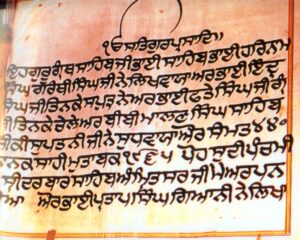
Within it’s 1430 pages, the shabads (hymns) of the Sri Guru Granth Sahib are arranged in thirty-one Ragas, the traditional Indian musical measures and scales. Within the Ragas, they are arranged by order of the Sikh Gurus, with the shabads of the Hindu and Muslim Saints following. The shabads are written in various meters and rhythms, and are organized accordingly. For instance, Ashtapadi – eight steps, or Panch-padi – five steps. The Sri Guru Granth Sahib is written in Gurmukhi script, but the shabads were written in many different languages including Punjabi, Sanskrit and Persian.
- Main article: Index of Guru Granth Sahib
The original bir of Guru Granth Sahib did not contain an index. However, this is provided in some modern print of the bir to make it easy to find the location of some of the common banis. For example, from the index, (see main article here) it can be seen that the Japji Sahib starts at page 1 and ends at page 8; Sukhmani Sahib is located from pages 262 to 296; the Bara Maha bani can is found at pages 133 to 136; The bani called Anand Sahib(Bliss) can be found at pages 917 to 922, etc.
The Beginning
The Guru Granth Sahib begins with the word “Ek Onkar” – The All Pervading Being. From this Word to the tenth Word “Gur-parshad” is called the Mool Mantra. After this is the rest of the composition called the Japji composed by Guru Nanak Dev. This comprises 38 Pauris or stanzas, a Prologue and an Epilogue. This is one of the morning prayer of the Sikhs.
The next composition has two parts – (1) “So Dar” and (2) “So Purkh”. The Bani, “So Dar” contains 5 Shabads and “So Purkh” contains 4 Shabads. This form most of the evening prayer of the Sikhs and is called the Rehras. After this is the Bani called Sohila (full name, Kirtan Sohila), which contains 5 Shabads and is the bed-time prayer.